AI as Your Strategy Partner, Not a Band-Aid

You've likely felt it: that subtle, persistent friction between the grand vision in your head and the daily reality of your operations. You have the spreadsheets, the 2026 goals, and a Slack workspace humming with activity. Yet, at the end of the quarter, the needle hasn't moved as far as you'd hoped.
This isn't a failure of ambition. It's an execution gap.
For years, technology has been sold as a "fix." If your team is overwhelmed, buy another SaaS tool. If your data is messy, install a dashboard. But these are Band-Aids — temporary patches on deeper structural misalignments. In the new era of business, we are moving beyond "tools" and into the realm of "partners." Specifically, Agentic AI is emerging not as a quicker way to do a task, but as a strategic companion that helps bridge the gap between where you are and where you're meant to be.
"Technology is an amplifier of your intention. When strategy meets soul, AI becomes the bridge to your most ambitious self."
— Andrea Florescu
The Execution Gap: Why Great Ideas Stagnate
Recent research shows that while 81% of companies have an AI strategy, only about 12% are actually executing it. This gap exists because strategy is often treated as a static document — a beautiful PDF that lives in a shared folder — while the team is busy fighting fires in the field.
When we treat AI as a Band-Aid, we ask it to do small, isolated things: "Write this email," or "Summarize this meeting." While helpful, this doesn't solve the execution gap. It just makes the chaos slightly faster. To truly scale, you need a Technology Strategy that integrates AI into the very fabric of your decision-making.
From Tools to Agents: Redefining Operational Freedom
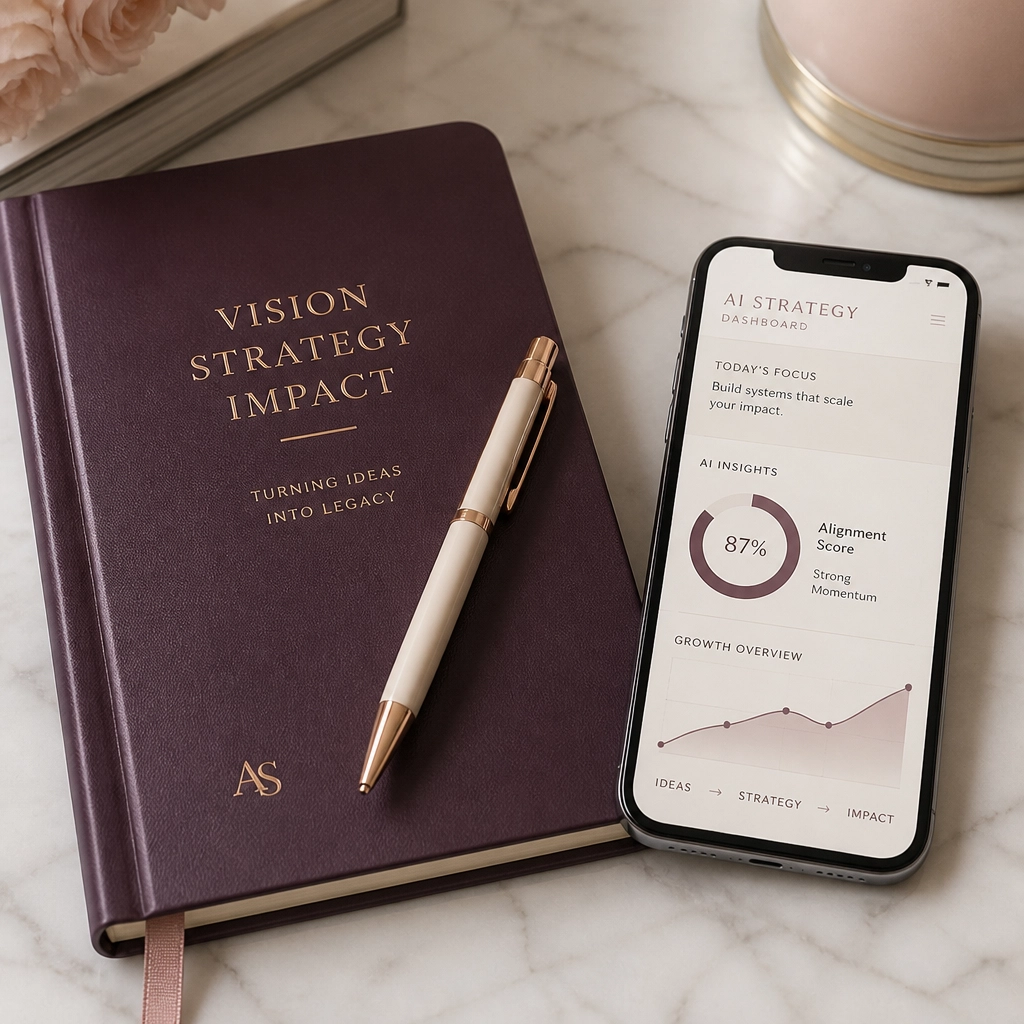
The shift we are seeing today is the rise of Agentic AI. Unlike traditional AI, which waits for a prompt to generate a single response, Agentic AI functions as a "digital teammate." It senses, decides, and acts within a loop of continuous execution.
Imagine a system that doesn't just tell you that your inventory is low (a tool), but instead notices the trend, cross-references it with upcoming marketing campaigns, negotiates a shipping window with your supplier, and drafts the purchase order for your approval (an agent).
This is what I call Scaling with Soul. By handing over the routine "sense-decide-act" loops to intelligent agents, you reclaim the mental white space required for high-level creative direction. You move from being a "manager of tasks" to a "steward of outcomes."
AI as a Soul-Booster, Not a Soul-Replacer
I often hear from CEOs who worry that bringing more AI into the business will make it feel "robotic" or "cold." My perspective is the opposite. When systems are designed with Digital Transformation in mind, they serve as soul-boosters.
If your marketing director is spending six hours a week manually pulling data from three different platforms, they aren't being "human" — they are being a calculator. When an AI agent handles that data orchestration, your director can spend those six hours brainstorming the emotional hook of your next campaign. That is where the "soul" of your business lives.
Three Pillars of Strategic AI Integration
To move from Band-Aids to partnership, you must focus on three core areas:
1. Strategic Outcomes First, Tech Second
Never start with the tool. Start with the "non-negotiable" strategic outcome. Do you need to reduce lead times? Increase your net promoter score? Once the outcome is clear, you can design an agentic workflow that directly supports it.
2. The Interoperability Layer
Agentic AI only works if it can "talk" to your other systems. This is why Tech Stack Optimization is critical. Your CRM, ERP, and communication tools must be connected so the AI has the context it needs to take meaningful action.
3. Governance as a Guardrail
Trust is earned, not given. Implement clear decision rights. Define what the AI can do autonomously and where it must "ask" for human intervention. This creates a safe environment for experimentation and growth.

The Role of Fractional Leadership
Building this bridge is rarely a solo journey. Many of the organizations I work with find themselves at a plateau because they lack the senior-level operational capacity to oversee these complex transformations. This is where Fractional COO becomes a powerful lever. You get the strategic depth of a seasoned COO or CTO to design these systems without the overhead of a full-time executive hire.
Closing the Loop
The future belongs to the leaders who can bridge the "Strategy + Soul" divide. AI is not here to replace the essence of your business; it is here to provide the structure that allows that essence to flourish. By treating AI as a partner in your strategic execution, you don't just solve today's problems — you build the freedom to create tomorrow's opportunities.
Frequently Asked Questions
What exactly is Agentic AI?
Agentic AI refers to autonomous or semi-autonomous systems that can plan and execute multi-step tasks to achieve a specific goal. Unlike a standard chatbot that answers a question, an agent can interact with other software, make decisions based on data, and follow through on actions.
How do I know if my business is ready for AI integration?
You are ready when you have a clear strategy but feel stuck in the "execution gap." If your team is spending more time on manual workflows and data entry than on high-value creative or strategic work, it's time to look at AI as a strategic partner.
Will AI replace my team?
No. In a "Strategy + Soul" framework, AI replaces the tasks that drain human energy, not the humans themselves. The goal is to elevate your team members from "doers" to "judges" and "stewards" of the AI agents, allowing them to focus on empathy, intuition, and complex problem-solving.
Where is the best place to start?
Start by identifying one high-leverage strategic outcome that is currently hindered by manual processes. Map out the decisions involved and look for ways an AI agent could support or automate those decisions. Often, a Technology Strategy audit is the best first step.
Resources for Your Journey
Close the execution gap — with intention.
Stop patching and start partnering. Whether through Technology Strategy or Digital Transformation, I help leaders like you build the bridge between ambition and reality.
Book a Strategy Call