Service · 03
Your systems should make the work easier. Sometimes they become part of the work.
I look at how the business works first, then at the technology supporting it.
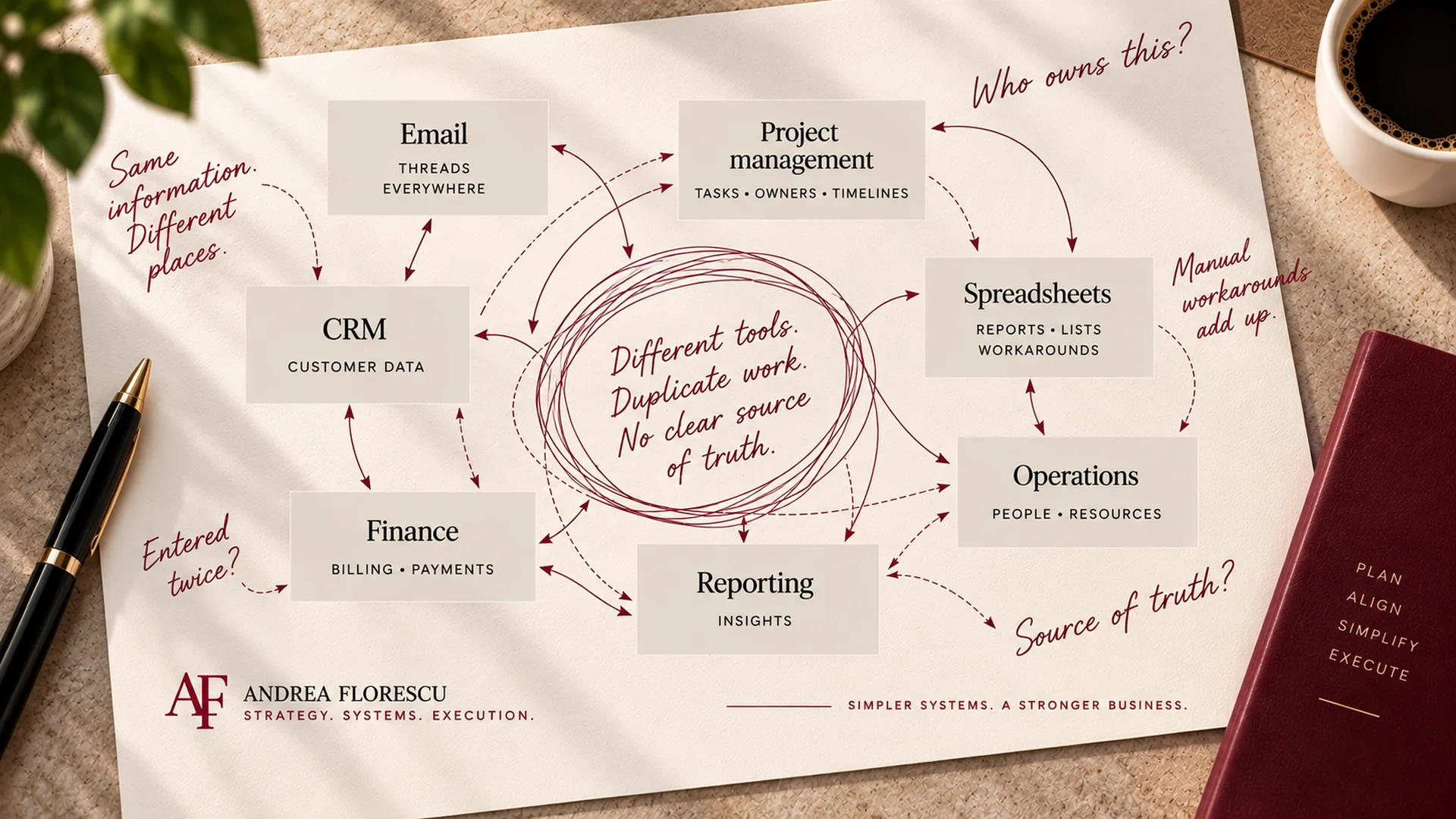
Most messy tech stacks made sense one decision at a time.
A growing company rarely deliberately designs a complicated set of systems.
Sales needs something, so a CRM gets added. Operations finds a project tool. Finance has its own system. Someone builds a spreadsheet to cover the gap between them.
Each decision can make sense on its own.
The trouble appears later, when the business has to operate across all of them. Information gets entered twice. Managers need someone to assemble the story before they can see what is happening. People work around the official process because the workaround is faster.
That is usually when another software purchase stops being a useful first move.
I look at the work, the information and the tools together.
A technology review starts with what your team is actually trying to accomplish.
I look at where work begins, who needs information next, where decisions happen, which systems are involved and where people have created manual work around them.
Then we can look at the technology with some context.
- tools that overlap or duplicate work;
- systems people use versus systems they work around;
- information entered in more than one place;
- missing or unreliable integrations;
- CRM or project-management configuration that no longer fits;
- reporting, automation and AI opportunities with a real business use.
The point is not to produce a longer technology list.
It is to understand what the business actually needs its systems to do.
What should stay. What should change. What should stop.
The answer is not automatically a smaller tech stack.
It is a more intentional one.
Keep
If it fits the work, people use it and the information is reliable, keep it.
Fix
Sometimes the capability already exists. The issue is ownership, setup, workflow design or adoption.
Connect
If information has to be copied manually from one place to another, there may be a better way to move it.
Replace
A system may genuinely have been outgrown. Requirements should come from the business process, not from a vendor demonstration.
Stop
Some reports, fields, subscriptions and workarounds survive simply because nobody has asked whether they are still necessary.
Removing work is also systems improvement.
The important decisions usually happen before software selection.
When a system frustrates people, replacing it can feel like the obvious answer.
Sometimes the software is capable and the problem is configuration. Sometimes nobody owns the information. Sometimes two tools are doing the same job. Sometimes the workflow itself is the problem.
And sometimes the spreadsheet is doing exactly what it should be doing.
Before recommending a change, I want to know which problem we are actually solving.

This is systems work, not outsourced IT.
I am not your managed IT provider, software reseller or help desk.
I am also not trying to automate every manual process or put AI into the business because AI happens to be available.
This work sits between the operation and the technology.
The question is whether your systems support how the company needs to run.
If the problem is primarily operational rather than technological, Operations Consulting may be the better fit.
If the company needs someone to remain inside the business and take operating responsibility while larger changes are carried through, that is Fractional COO work.
If the challenge is broader than the technology stack and involves replacing entrenched processes and ways of working across the organization, that may become Business Modernization.
How I approach the work
Audit
Build a clear picture of the systems, workflows, information sources and manual work actually in use.
Clarify
Identify where the friction comes from: the tool, configuration, ownership, workflow or handoff.
Sequence
Decide what should happen first and what depends on what.
Document
Create a clear path forward with the decisions, dependencies and ownership recorded.
This work may make sense when…
- your team enters the same information in several places;
- nobody agrees on which system is the source of truth;
- spreadsheets are filling gaps between systems;
- people work outside the process because the system slows them down;
- leadership cannot see what is happening without someone assembling the information;
- you are considering a major software purchase, automation or AI use case and need the requirements clear first.
You do not need all of these.
One expensive, persistent systems problem is enough reason to look closely at what is underneath it.
Better systems are usually less noticeable.
- People know where information belongs.
- The next person gets what they need.
- Managers can see what is happening without reconstructing the story.
- The team does not have to remember which workaround applies this time.
- Technology becomes part of how the work gets done instead of another layer the team has to manage.
That is the standard.
Related reading
-
10 Reasons Your Tech Stack Is Creating More Work
Why software accumulation creates operational friction long before anyone calls it a technology problem.
-
The Founder Bottleneck Isn't a Systems Problem
Where technology helps, where it does not, and why founder dependency requires a different kind of fix.
Start with what is creating the work.
You do not need to know whether the answer is a new system, better configuration or a cleaner workflow.
Tell me what keeps breaking, getting repeated or requiring someone to work around the system.
We can start there.