
Every growing company hits the same wall, and every founder is handed the same map for getting over it: build better systems, hire ahead of the curve, buy the tool that finally fixes it. I've spent years inside companies climbing through exactly that stretch — roughly the distance from a first million to a fifth — and I've watched that map fail more often than it works. Not because systems don't matter. Because they're almost never the first thing that's broken.
The scene inside those companies is remarkably consistent. The founder is exhausted. The team is busy. The calendar is full. And somewhere in the last year, the business quietly stopped moving at the speed it used to. Everyone is working hard, and nothing is getting easier — and the instinct, every time, is to reach for a system.
But the founder who decides everything is exactly what carries a company to its first million. It's also what stalls it before its fifth. Most founders at this stage don't have a business that's hard to run. They have a business only they can run. From the inside, those two feel identical. They are not the same problem — and no tool solves the second one.
Businesses rarely have a systems problem first. They have a clarity problem.The Founder Clarity Method™
Clarity gets treated as a soft word, so let me make it exact. Clarity isn't one thing. It has three dimensions, and a growing business needs all three. When one goes missing, it fails in a specific way you can learn to recognize on sight. The Three Dimensions of Founder Clarity™ are:

These three aren't a list. They're a chain. You can't own an outcome that was never named a priority, and you can't hold authority over something you don't own. Priority makes ownership possible; ownership makes decision possible. And that structure produces the most useful thing I've learned watching this pattern repeat across company after company.
The dimension you feel is rarely the one that's broken.The Founder Clarity Method™
What the founder feels is the last link in the chain — every decision routing back to them, a day spent resolving things only they can resolve. So they try to fix decisions: delegate harder, empower the team, push authority down. It doesn't hold, because the break was upstream. People aren't escalating because they lack authority. They're escalating because no one named the priority, so no one could truly own the outcome, so no one feels safe deciding. The bottleneck sits at the bottom of the chain. The cause usually sits at the top.
This is also why the usual fix doesn't take. A system is simply a decision you've made once so you never have to make it again — which means a system can only carry a decision that was already clear. Lay one over an unclear decision and you haven't removed the confusion. You've automated it. Systems preserve clarity. They cannot create it.
That's the order of operations, and most founders run it backwards. So before you scale, or buy another tool, the question was never what system is missing. It's which dimension of clarity has broken — because each one breaks differently, and each one is fixed differently.
01Why the Bottleneck Hides in Plain Sight
A clarity problem never shows up labeled as one. It arrives as a dozen small frictions that look unrelated — a slipped deadline, a piece of work done twice, a decision that sat in your inbox for a week. You solve them one at a time and never notice that they rhyme. Here are the three signs, each pointing to the dimension underneath it. You are almost certainly living with one of them right now and calling it growth.
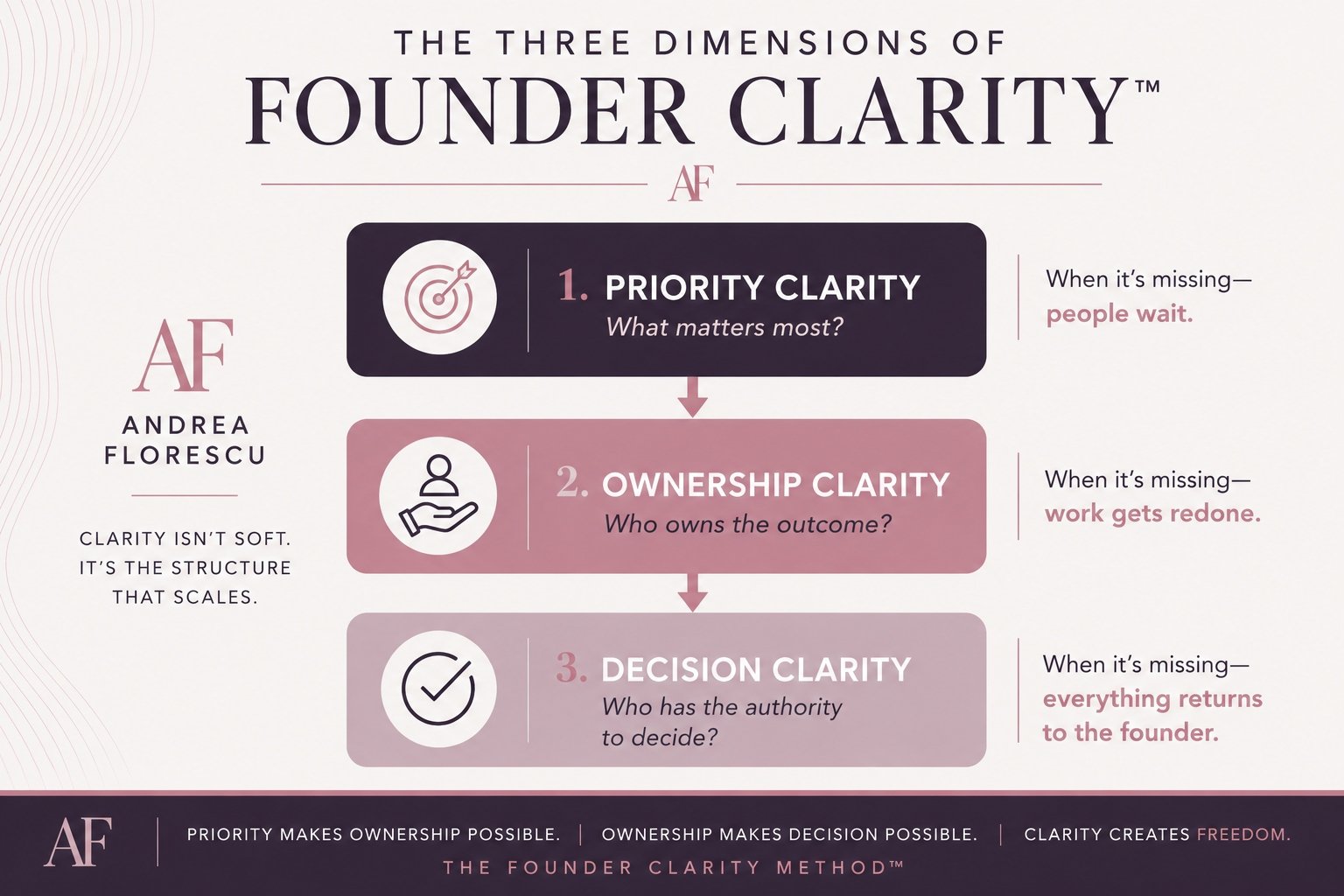
Priority Clarity · Busy, and Standing Still
Everyone is working. The output is real. And the few moves that would actually change the trajectory keep sliding a week, then another. The tell is a priorities list with nine things on it — which a team correctly reads as no priorities at all, so they work on whatever sits closest to their desk. Busy is what a team does when it doesn't know what matters. Motion is the easiest thing in a business to mistake for progress.
Ownership Clarity · The Work That Comes Back
A deliverable returns wrong and gets redone. Two people built the same thing without knowing. A decision gets made, quietly unmade, then made again. Ask who owns it and you get three names, or a meeting to decide who owns it. When everyone owns a little of an outcome, it gets handled by many and finished by none. Work gets redone because no one was ever certain it was theirs to finish.
Decision Clarity · You, Interrupted All Day
This is the one you feel. Count, across a single week, how often someone comes to you not to inform you but to get a decision — the “got a sec?” that's really a request for permission, the thread you're copied on “just to be safe,” the approval that bounces back to your desk. If the work can't move until you weigh in, the team doesn't need more of you. No one else knows what they're allowed to decide.
This is the bottleneck, named exactly. Not how much you do — how much can't happen without you. And it's the one no tool will ever reach, because the tool only routes the same decisions back to you behind a cleaner interface.
02Founder Burnout Is a Clarity Symptom, Not a Workload One
This should be said plainly, because founder burnout gets treated as a scheduling problem and almost never is.
You don't burn out from working hard on things that are clear. You burn out from being the only place clarity lives. When you're the source of every priority, the final word on every outcome, and the last stop for every decision, then every unresolved thing in the business carries the same address — yours. Your plate isn't full because you took on too much. It's full because the business has no other way to resolve ambiguity, so all of it ends up on your desk.
This is why “take things off your plate” never holds. You can hand off the task. You cannot hand off the ambiguity — it comes straight back the moment someone hits a decision they aren't sure is theirs. Past a certain size, founder leadership is mostly the work of making sure clarity doesn't have to come from you every time.
Why Clarity Comes Before Systems
Once you see the constraint this way, the sequence is obvious, and it's the reverse of what most founders do. Clarity first. Systems second. Every time.

A system makes clarity repeatable. It takes a decision you've already made and runs it without you — exactly the leverage you want, but only when there's a clear decision underneath to carry. Build the system first, over unsettled priorities and unowned work, and you don't get leverage. You get the same confusion, faster, and harder to unwind. Run it in the right order and you can build a business that runs itself — clarity first, then the systems that carry it.
You can't systematize your way out of a problem that systems can't reach.Andrea-ism
It's also the line between a business that scales and one that just gets heavier. A company scales when it stops needing the founder to think for it — and that only happens when clarity lives in the business instead of in the founder's head. Across the engagements I've documented, reducing founder bottlenecks through leadership structure has been one of the clearest ways to move decision-making out of the founder's head and into the business. Add people and tools to a clear business and the clarity holds. Add them to an unclear one and the founder doesn't get freer; the confusion simply gains more places to live. Decision-making for founders was never about deciding faster. When you're ready to translate clarity into smarter tools and workflows, business modernization helps ensure systems serve the structure you've already defined — it's about deciding which decisions should still reach you, and making the rest clear enough that they never do.
The Logical Next Step
Operational clarity isn't a document. Documents are systems; they come second. Clarity is simpler and harder to fake: whether the people in your business can answer three questions without walking to your desk. What matters most. Who owns this. Who decides. When those are clear, the bottleneck isn't managed. It dissolves — because the thing creating it, ambiguity with nowhere to go but you, is finally gone.
You already know the bottleneck is there. What you can't see by feel is which dimension caused it — because the one you feel is rarely the one that broke. That isn't a flaw in your judgment. It's the nature of the chain: the symptom shows up at the bottom while the cause sits at the top, which is exactly why working harder on the part you can feel never quite works.
So the first move isn't building. It's locating. If you've already run your mid-year numbers, the next question is who's actually equipped to act on them.
Find out which dimension of clarity has broken.
The Founder Diagnostic™ is the first step in the Founder Clarity Method™ — a structured way to find whether the break is in priority, ownership, or decision clarity, before you spend another dollar systematizing a problem systems can't reach. Not a strategy session. A diagnosis of the real constraint, so the next thing you build is the right thing.
See which dimension is breaking →Founder Bottleneck FAQ
What is a founder bottleneck?
A founder bottleneck happens when a growing business can't move forward without the founder personally weighing in — on priorities, ownership, or decisions. It's not a workload problem; it's a sign that clarity in the business still lives only in the founder's head.
Is the founder bottleneck a systems problem?
Usually not. Systems make an already-clear decision repeatable — they can't create clarity that doesn't exist yet. If you add systems before the underlying priority, ownership, or decision is clear, you get the same confusion, just faster and harder to unwind.
What are the Three Dimensions of Founder Clarity™?
Priority Clarity™ (what matters most), Ownership Clarity™ (who owns the outcome), and Decision Clarity™ (who has the authority to decide). They function as a chain — priority makes ownership possible, and ownership makes decision possible.
How do I know which dimension of clarity is broken in my business?
Look at where the friction actually shows up. If people are waiting on direction, that's a priority issue. If work keeps getting redone, that's an ownership issue. If everything routes back to you personally, that's a decision issue — though the real cause is often upstream from what you feel.
Why does founder burnout happen even when the team is capable?
Burnout isn't caused by task volume alone — it's caused by being the only place in the business where ambiguity gets resolved. A capable team can still route every unclear decision back to the founder if priority and ownership were never made explicit.
Can I delegate my way out of a founder bottleneck?
Not by itself. You can hand off a task, but you can't hand off ambiguity — it comes back the moment someone hits a decision they're not sure is theirs to make. Delegation only holds once priority and ownership are already clear.
What is the Founder Diagnostic™?
It's the first step in the Founder Clarity Method™ — a structured way to identify exactly which dimension of clarity (priority, ownership, or decision) has broken in a business, before spending time or money on systems that can't fix the actual cause.
At what stage of growth does the founder bottleneck usually appear?
It tends to surface in the stretch between a business's first million and its fifth — the point where the founder-led decision-making that built early momentum starts working against further growth.