
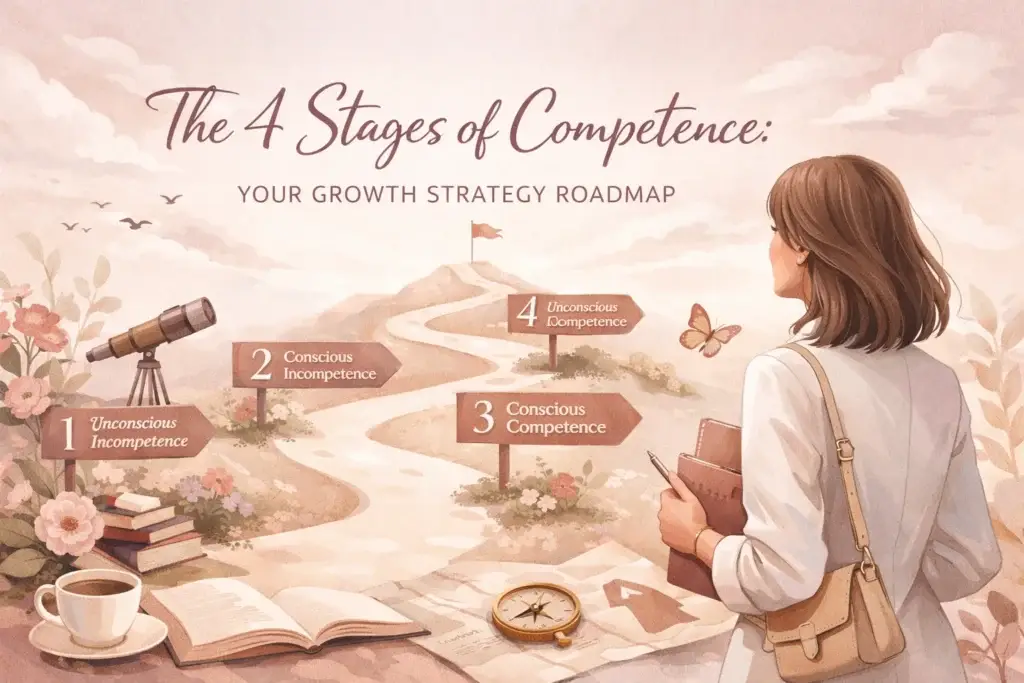
Scaling a business isn’t just about hitting a revenue target or hiring a bigger team. It’s a psychological evolution. If you feel like you’re hitting a ceiling, it’s usually because you’re trying to solve level-ten problems with a level-two mindset.
Most entrepreneurs think the “bottleneck” is their marketing or their tech stack. (Spoiler alert: It’s usually the person in the mirror). To move from a solo-operator mentality to a high-level CEO, you have to navigate the four stages of competence. It’s the roadmap for how we learn, how we lead, and ultimately, how we scale.
> “Growth isn’t found in what you already know; it’s forged in the discomfort of what you haven’t mastered yet.” , The Andrea Florescu Standard.
Let’s break down the four stages of your growth journey and, more importantly, how to stop getting stuck in the “messy middle.”
This is the honeymoon phase of business. You have a great idea, a lot of passion, and absolutely no clue how hard this is actually going to be. You don’t know what you don’t know.
In this stage, you might be winging your sales calls, guessing your margins, and “vibing” your way through social media. You’re likely experiencing what some call the Dunning-Kruger effect, you’re highly confident despite having very little actual data to back it up.
The Growth Risk: Overconfidence can lead to expensive mistakes. You might skip building a Foundation for Success because you think you’ve already got it figured out.
The Fix:
Welcome to the “Valley of Despair.” This is the moment you realize that your “vibe-based” strategy isn’t scalable. You become painfully aware of the gaps in your knowledge. Maybe you realize you’re terrible at managing people, or your financial forecasting is basically just a wish list.
This stage feels like imposter syndrome, but it’s actually a sign of progress. You’ve moved from ignorance to awareness. (And yes, it’s supposed to feel a little uncomfortable).

The Growth Risk: This is where most people quit or “pivot” (which is often just a fancy word for running away). They mistake the discomfort of learning for a sign that they’re in the wrong business.
The Fix:
You’ve done the work. You’ve taken the courses, hired the consultant, and built the SOPs. Now, you can perform the task well, but it takes all of your focus. It’s not second nature yet.
If you’re in the Growth Stage, you’re likely here. You’re running the systems, but if you take your eye off the ball for a second, things start to wobble. It’s exhausting because your brain is working overtime to ensure every “i” is dotted and every “t” is crossed.
The Growth Risk: Burnout. Because you can do it all, you often do do it all. You become the bottleneck because the systems rely on your constant supervision.
The Fix:

This is the Holy Grail. You’ve practiced, failed, adjusted, and repeated the cycle so many times that excellence is now your default setting. You don’t have to “think” about being a leader; you just are one. Your business systems run without you having to check the dashboard every five minutes.
At this stage, you are ready for the Scale Stage. You have the mental white space to think about 3-year visions instead of 3-hour fires.
The Growth Risk: Complacency. When things become easy, we stop innovating. This is why most brands don’t grow: they get comfortable and forget that the market is always evolving.
The Fix:
The biggest mistake I see high-achievers make is trying to skip stages. You cannot go from “not knowing anything” to “total mastery” overnight. You have to earn your way through the conscious incompetence phase.
Think of technology and AI as your amplifiers here. They don’t replace the need for you to learn the skill, but they act as “soul-boosters” that shorten the time you spend in the “Grind” phase. They give you the creative freedom to focus on what actually moves the needle.

How long does it take to reach Unconscious Competence?
There’s no magic number (forget the 10,000-hour rule for a second). It’s about the intensity and frequency of the practice. In a fast-paced business environment, you can achieve mastery in months if you are disciplined about your Your Year By Design strategy.
Why do I feel like I’m moving backward sometimes?
Whenever you scale, you’re essentially starting a new game. You might be a “Stage 4” marketer but a “Stage 2” CEO. It’s normal to feel like a beginner again when the stakes get higher.
Can I be in different stages for different parts of my business?
Absolutely. In fact, you probably are. The goal is to identify which area is your weakest link and focus your development there.
Is it possible to stay in Stage 4 forever?
Possible? Yes. Recommended? No. If you’re not feeling the “itch” of Stage 2 (Conscious Incompetence) in some area of your life, you’re likely stagnating. Growth requires a constant cycle of learning and unlearning.
Success isn’t a result of luck or “hustle”: it’s a result of systems and strategy. If you’re ready to move out of the “Grind” and into “Flow,” you need a roadmap that accounts for both your business operations and your personal evolution.
Are you ready to see where your gaps are? Let’s design a strategy that actually scales.